The Australian higher education landscape is currently navigating its most significant transformation since the Dawkins Reforms of the late 1980s. As we move through 2026, the traditional “lecture-tutorial” model is being superseded by a borderless, digital-first ecosystem. With the Tertiary Education Quality and Standards Agency (TEQSA) shifting its focus toward hybrid competency and AI-integrated assessments, the “learning gap”—the disparity between curriculum demands and student support—has never been more apparent.
The Digital Shift: Beyond the Classroom
Historically, Australian universities like the University of Melbourne and ANU relied on physical infrastructure to define academic excellence. Today, the definition of a “campus” has evolved. Digital support systems—ranging from AI-driven research repositories to real-time academic mentoring—are no longer luxury add-ons; they are pedagogical necessities.
As international student numbers stabilise and domestic cost-of-living pressures rise, the demand for flexible, high-quality academic assistance has surged. In this climate, many students find that online assignment help services by MyAssignmentHelp provide the essential bridge needed to navigate complex unit requirements while balancing professional commitments. These platforms offer more than just answers; they provide the structural scaffolding that traditional crowded lecture halls often fail to deliver.
Closing the Gap: Data-Driven Insights
According to recent 2025-2026 student experience surveys, approximately 68% of tertiary students in Australia engage with at least one external digital learning tool weekly. The “Learning Gap” specifically refers to the distance between a student’s current understanding and the “High Distinction” criteria set by rigorous Australian marking rubrics.
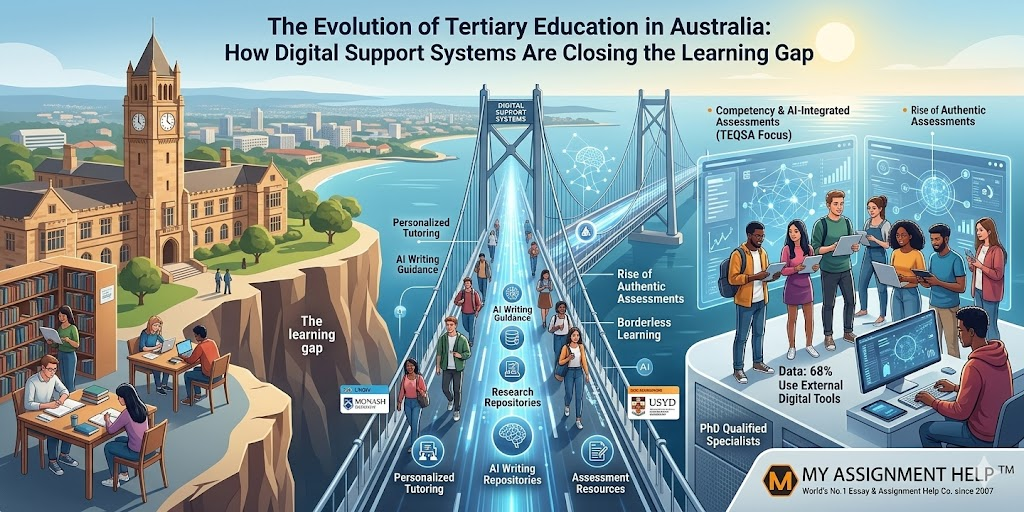
Factors Driving the Evolution:
- The Rise of Authentic Assessment: Universities are moving away from traditional exams toward “real-world” projects. This requires a higher level of critical thinking and technical execution.
- Socio-Economic Diversity: With more “first-in-family” students entering Australian universities, there is a greater need for personalised guidance that mirrors the level of support found in private elite colleges.
- The AI Integration Era: Rather than banning AI, institutions are teaching students how to co-create with technology, necessitating expert human oversight to maintain academic integrity.
For many, the pressure of these evolving standards leads to a search for reliable experts to do my assignment, ensuring that the final submission meets the nuanced linguistic and structural expectations of Australian faculty.
The Role of External Academic Mentoring
The evolution of education has birthed a new era of “On-Demand Academic Support.” Digital systems allow for a level of granular feedback that was previously impossible. When a student in Brisbane or Adelaide can access a PhD-qualified specialist at 10 PM to clarify a complex legal case study or a nursing care plan, the learning gap begins to close.
Information Gain: What the Data Tells Us
| Support Type | Accessibility | Impact on Retention | Impact on Grades |
| Traditional Office Hours | Low (Scheduled) | Moderate | Variable |
| Peer-to-Peer Forums | High | Low | Mixed |
| Digital Support Systems | 24/7 | High | Significant Improvement |
Key Takeaways
- Hybridity is Permanent: Australian tertiary education is now a blend of institutional curriculum and external digital support.
- Quality Over Quantity: Closing the learning gap requires high-quality, human-led intervention rather than automated AI generation alone.
- Accessibility Matters: Digital platforms are democratising HD-level support for students across all Australian states.
FAQ Section
Q1: Is using digital support systems considered academic misconduct in Australia?
A1: No. Using external resources for tutoring, guidance, and clarifying complex concepts is a standard part of modern learning. However, students should always use these tools to enhance their own understanding and ensure their final work is their own.
Q2: How do digital support systems align with TEQSA standards?
A2: High-quality support systems focus on “Experience, Expertise, Authoritativeness, and Trustworthiness” (E-E-A-T), providing educational value that helps students meet the rigorous standards set by TEQSA.
Q3: Are these services available for all Australian universities?
A3: Yes, digital support is designed to align with the specific handbooks and marking criteria of major institutions, including the Group of Eight (Go8) and innovative technology universities.
See also: Everything You Need to Know About Clear Acrylic Keychains by Vograce
About the Author: Dr. Elena Richardson
Senior Content Strategist & Academic Consultant at MyAssignmentHelp
With over 12 years of experience in the Australian higher education sector, Dr. Elena Richardson specialises in curriculum design and student success strategies. Having previously tutored at leading Victorian universities, she now focuses on leveraging digital tools to make high-level academic support accessible to a diverse student body. Her work focuses on maintaining the delicate balance between technological innovation and academic integrity.
References & Sources:
- Department of Education, Skills and Employment (DESE) – 2025 Student Outcome Reports.
- TEQSA 2026 Framework for Digital Learning and Academic Integrity.
- Universities Australia: The State of the Sector Report (2025).
- Journal of Higher Education Policy and Management: “The Digital Divide in Australian Tertiary Education.”